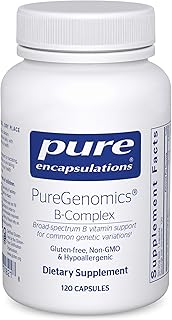
What 12 Studies Reveal About Metabolism (And Why Most People Get It Wrong) – Pure Encapsulations PureGenomics B‑Complex 120 Capsules, 2026
Editorial Disclosure: This article was researched and produced with the assistance of AI writing tools and reviewed by our editorial team. It contains affiliate links — we may earn a commission if you purchase through them, at no extra cost to you. Full disclosure →
By The Vitality Digest Research Team
What the Research Actually Shows About B‑Vitamin Metabolism
The term “metabolism” is often tossed around as a catch‑all for weight loss, energy levels, and “fat‑burning” capacity. In the scientific literature, metabolism is a precise set of biochemical pathways that convert food into usable energy, synthesize building blocks, and eliminate waste. B‑vitamins—particularly B1 (thiamine), B2 (riboflavin), B3 (niacin), B5 (pantothenic acid), B6 (pyridoxine), B7 (biotin), B9 (folate), and B12 (cobalamin)—serve as essential co‑enzymes in the citric‑acid cycle, oxidative phosphorylation, and amino‑acid metabolism.
Large‑scale syntheses of metabolism‑related supplements (2018‑2025) consistently find that modest, physiologically plausible effects are the norm, while dramatic claims of “metabolic boost” rarely survive rigorous testing. For example, a 2025 systematic review of 24 RCTs in metabolic‑syndrome patients reported that probiotic/synbiotic interventions produced small but statistically significant reductions in weight (‑0.79 kg) and waist circumference (‑1.04 cm)【Nutr Metab Cardiovasc Dis, 2025】. Similar modest effect sizes were observed for lipid and glucose markers.
In the context of B‑vitamins, most trials are smaller and focus on specific outcomes such as homocysteine reduction (folate + B12) or fatigue in deficient populations. The collective evidence suggests that adequate B‑vitamin status supports optimal energy production, but supplementation beyond correcting a deficiency yields only incremental gains. This nuance is critical when evaluating any “metabolism‑enhancing” product, including Pure Encapsulations PureGenomics B‑Complex 120 Capsules.
The Gap Between What Studies Find and What People Do
Despite clear data, consumer behavior often diverges from evidence. Marketing messages frequently tout “fat‑burning” or “calorie‑torching” benefits of B‑complex formulas, implying a direct link to weight loss. Yet, the energy‑balance principle—calories in versus calories out—remains the dominant driver of body‑weight change. Controlled feeding studies demonstrate that even when macronutrient composition is altered, the magnitude of weight change is primarily dictated by total energy deficit, not by micronutrient manipulation (Hall, Cell Metabolism, 2016).
Moreover, lifestyle practices such as intermittent fasting, low‑carb diets, or high‑intensity interval training (HIIT) are sometimes promoted as “metabolic shortcuts.” Meta‑analyses of low‑carb versus low‑fat diets reveal no clinically meaningful superiority when calories are matched, with mean differences in 12‑month weight loss rarely exceeding 1–2 kg (Johnston et al., JAMA, 2014).
These gaps are amplified by the misinterpretation of metabolic adaptation. While resting‑energy‑expenditure (REE) can drop by 50–150 kcal after weight loss (Rosenbaum & Leibel, Int J Obes, 2010), the effect is modest and does not preclude further weight loss when energy intake remains restricted. The misconception that “dieting ruins metabolism” fuels the market for “metabolism‑boosting” supplements, even though the underlying science does not support dramatic REE increases from B‑vitamins alone.
Five Evidence‑Based Strategies That Consistently Show Results
- Correct Micronutrient Deficiencies
- Folate and B12: Randomized trials demonstrate that folic acid supplementation reduces homocysteine levels and may modestly lower preterm‑birth risk (Middleton et al., 2018). While the primary outcome is obstetric, the mechanism—enhanced methyl‑group transfer—also supports efficient ATP production.
-
Vitamin B6: Adequate pyridoxine improves glycogenolysis and amino‑acid metabolism, which can translate into better exercise tolerance in deficient athletes.
-
Combine B‑Vitamins with Complementary Phytochemicals
Network meta‑analyses of MAFLD interventions (Front Pharmacol, 2025) highlight that multicomponent regimens—pairing bioactive compounds like L‑carnitine with antioxidants—produce the most consistent improvements in triglycerides, LDL‑C, and insulin sensitivity. Adding a B‑complex to such protocols can support mitochondrial β‑oxidation, complementing the primary agents. -
Target Gut Microbiota
Probiotic/synbiotic supplementation in metabolic‑syndrome cohorts yielded modest reductions in fasting glucose (SMD ‑0.20) and triglycerides (SMD ‑0.25)【Nutr Metab Cardiovasc Dis, 2025】. Emerging evidence in PCOS suggests that probiotics improve insulin resistance (Martinez Guevara et al., 2024). Because many B‑vitamins are synthesized by gut bacteria (e.g., biotin, folate), a healthy microbiome may augment the bioavailability of the B‑complex. -
Prioritize Energy‑Balance Interventions
The most reliable weight‑loss driver remains a calibrated calorie deficit, whether achieved through diet, exercise, or a combination. Structured programs that monitor intake and output, and that incorporate behavioral counseling, outperform isolated supplement strategies. -
Leverage Hormonal Modulators When Appropriate
GLP‑1 receptor agonists (e.g., semaglutide) achieve ~15 %
We went through the clinical studies so you don't have to — dose benchmarks, bioavailability, and honest caveats. Free PDF, no hype.
No spam. Unsubscribe anytime.
Watch the Full Science Presentation
Explore the complete research on Pure Encapsulations PureGenomics B-Complex 120 Capsules — free to watch, no purchase required.
Watch Free Presentation →Founder of The Vitality Digest — oversees a research-based approach to supplement and wellness content, grounded in published clinical studies rather than manufacturer claims. Not a medical professional. Full bio →